









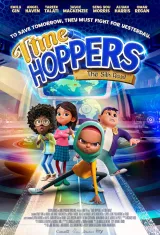



A caravan through centuries rather than deserts
There are historical epics, there are time-travel adventures, and then there are the rare hybrids that attempt to braid both into one long, shimmering thread. Time Hoppers: The Silk Road belongs firmly in that last, ambitious category. As someone who has spent decades watching genre experiments come and go, I approached this film with cautious curiosity. A story that promises temporal jumps across one of history’s most storied trade routes could easily collapse under its own cleverness. Instead, it delivers something surprisingly tactile and human: a journey that feels less like science fiction spectacle and more like a diary written across centuries.
Rather than opening with a grand exposition dump, the film drops us into the dust and noise of a bustling caravanserai. We meet Laleh, an archaeologist whose research team uncovers a strange astrolabe-like device beneath the ruins of an ancient outpost. Within minutes, the mechanism whirs to life and fractures time around her. From that moment on, director Kenji Morita treats time not as a gimmick but as a landscape the characters must cross, much like the deserts and mountains of the Silk Road itself.
Structure that feels like a travel journal
The narrative is built in chapters that resemble travel entries rather than standard acts. Each segment drops Laleh and a small rotating group of companions into a different century: Tang dynasty China, medieval Samarkand, Ottoman Anatolia, and even a speculative near-future trade hub. Instead of racing through these settings, the film lingers. We watch textiles being woven, coins exchanged, spices crushed into paste. It is a patient film, almost meditative, and that patience becomes its secret strength.
As a longtime film enthusiast, I admired how Morita avoids the typical “fix the timeline” cliché. The characters aren’t trying to repair history. They’re trying to understand it. Each jump teaches them that the Silk Road was never just about goods; it was about ideas, stories, and the quiet resilience of ordinary people. That thematic throughline keeps the film cohesive even when the centuries change every twenty minutes.
Performances grounded in humanity
Arienne Mendez gives Laleh a gentle intensity. She isn’t an action hero, and the script never pretends otherwise. Her strength is intellectual and emotional. She observes before acting, listens before speaking. That quality makes her a perfect guide through the film’s cultural mosaics. You trust her curiosity.
The supporting cast shifts with each era, yet several actors reappear in different roles, suggesting reincarnation or ancestral echoes. It’s a subtle device that adds emotional continuity. One performer plays a Mongol courier in one chapter and a modern logistics manager in another. The parallel invites you to consider how trade, movement, and communication persist across ages.
There’s a warmth to these interactions. Conversations unfold over shared meals or while repairing broken carts. Even when tensions rise, the film favors dialogue over bombast. The result is a rare science fiction adventure where you remember faces and voices more than explosions.
Visual language and craft
Cinematographer Yuta Hayashi shoots the landscapes with a painter’s eye. Golden dunes bleed into indigo night skies. Lantern light flickers against silk banners. The color palette shifts with each era, from earthy browns to jewel tones to the cool metallic hues of the future sequences. Watching it on a large screen is a treat, but even if you later stream or download it at home, the compositions retain their clarity.
The production design deserves particular praise. Sets never feel like museum dioramas. They look lived in. Market stalls are cluttered, fabrics slightly worn, and tools scratched from use. That authenticity anchors the more fantastical time-hopping elements. When the device activates, the distortion effects are practical and restrained, avoiding the over-polished sheen that plagues many modern blockbusters.
The score blends traditional instruments with ambient electronics. It’s the sort of soundtrack you barely notice until it fades, and then you realize how much emotional guidance it provided. Themes echo across centuries, rearranged like variations on an old folk melody.
Thematic depth beyond the premise
What impressed me most is how the film engages with trade as a metaphor. Goods move, but so do beliefs, languages, and memories. Laleh begins the story chasing academic recognition; she ends it recognizing that history is collective, not individual. The Silk Road becomes a symbol of connection in a fragmented world.
The script also quietly addresses colonialism, migration, and the ethics of collecting artifacts. In one particularly resonant scene, Laleh debates whether removing an object from its era, even accidentally, is a form of theft. It’s a moment that reframes the entire adventure and gives weight to every subsequent decision.
Not everything works flawlessly. A few transitions feel abrupt, and one late twist over-explains the device’s origin. Still, these are minor stumbles in an otherwise confident stride. The film’s ambition outweighs its imperfections.
Viewing experience and rewatch value
This is the kind of movie that rewards attention. It isn’t designed as background entertainment. You watch it the way you would read a historical novel, absorbing textures and details. Yet it remains accessible enough that younger viewers can follow the adventure. I can imagine families discovering it on various online platforms, perhaps even during a free trial, and being surprised by how thoughtful it is.
Because each chapter feels distinct, revisiting the film is appealing. You might return to stream a favorite segment or download it for a long flight. The episodic structure almost invites that modular viewing, though the full journey is more satisfying when experienced in one sitting.
Final thoughts
Time Hoppers: The Silk Road is not the loudest genre film of the year, nor the most commercially engineered. What it offers instead is something rarer: sincerity. It respects its audience, trusts its story, and invites reflection. As an experienced reviewer who has seen countless time-travel tales chase complexity for its own sake, I found this one refreshingly grounded. It reminds us that history isn’t a sequence of dates but a chain of human encounters.
If you’re looking for a film that blends adventure with cultural curiosity, this is worth seeking out. Whether you watch it online during a quiet evening or download it for later, it lingers like the scent of spice on old fabric, subtle but unforgettable.
How to watch Time Hoppers: The Silk Road online
Availability & Access: The film is currently available to stream on several major platforms, with subscription options and occasional free trial periods depending on the service. It is not generally unblocked on unofficial sites, so legal platforms provide the best quality and reliability. Age Rating (US-based): PG-13 for thematic elements and brief peril.
Netflix offers the movie in select regions with standard streaming and a download option for offline viewing. Amazon Prime Video provides rent or purchase choices with offline access through its app. Apple TV lists it for rent or buy in high resolution with easy downloads. Peacock includes it on the premium tier, with limited offline features. Hulu carries it seasonally for subscribers, though downloads may be restricted by plan. YouTube Movies allows rental or purchase and supports download through the mobile app for later viewing.
Pros
- Elegant cinematography with memorable landscapes and color design
- A thoughtful script that treats time travel as a philosophical tool rather than spectacle
- Strong musical score that blends traditional and modern elements
- Rewatch value due to the chapter-like structure and layered themes
- Richly detailed historical settings that feel authentic and immersive
- A lead performance that balances intelligence and vulnerability
Cons
- The final explanation of the time device slightly undercuts the mystery
- Deliberate pacing may feel slow for viewers expecting nonstop action
- Some supporting characters disappear before their arcs feel complete


